
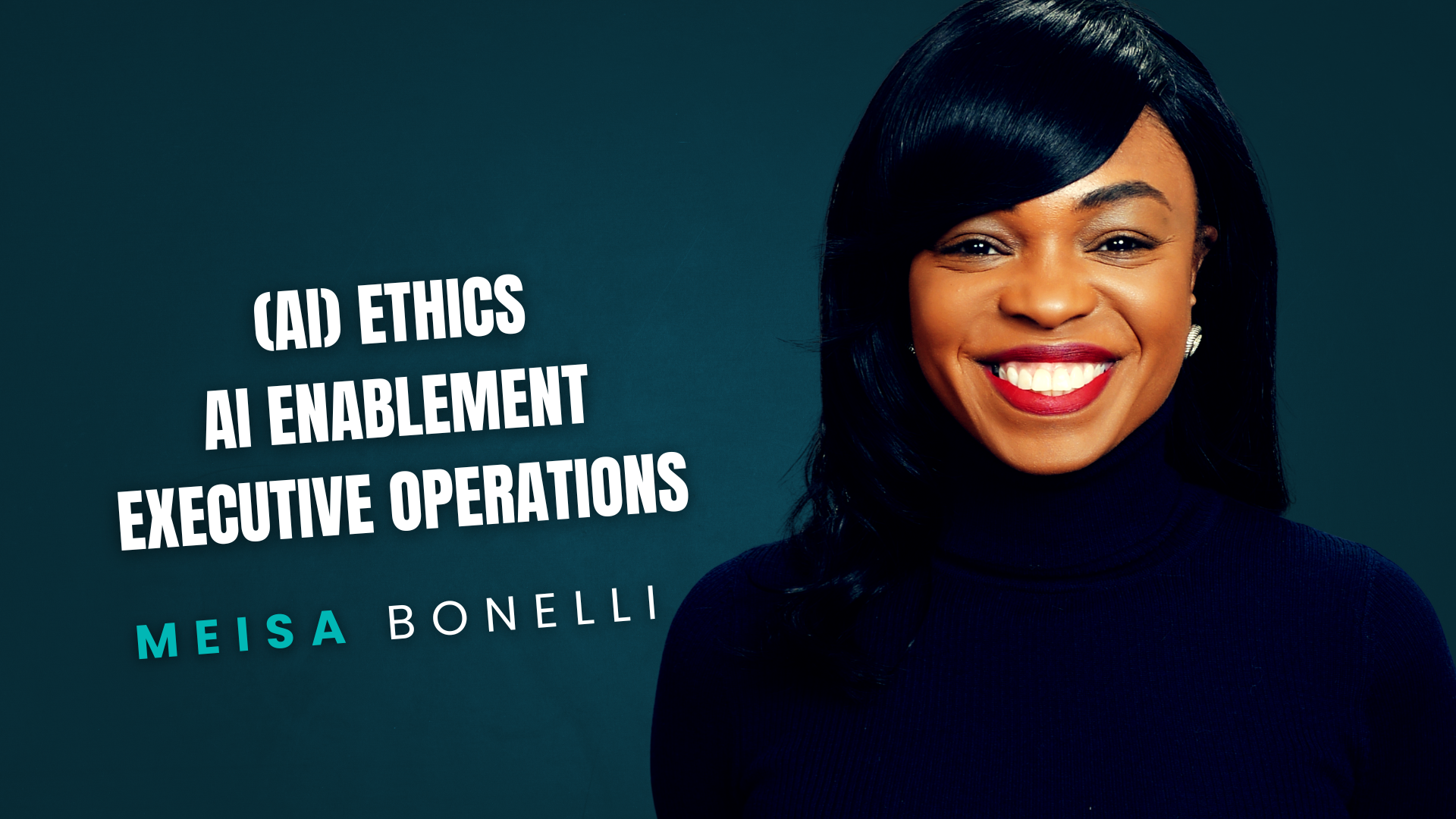
Executive Operations Now…
Executive work has changed. Information moves faster, decisions are made under greater pressure, and AI is now part of the workflow, whether intentionally designed or quietly improvised. What has not changed is the need for clarity, judgment, and trust at the top.
Meisa Bonelli partners with senior leaders to modernize how executive work gets done. Her focus is executive operations that are intelligent by design, where AI and automation support preparation, continuity, and follow-through, while human judgment, discretion, and relationships remain central.
Her background spans executive support, Chief of Staff leadership, operations management, compliance, and education. That combination allows her to translate between strategy and execution, technology and people, governance and momentum. She does not simply manage flow; she designs the conditions that allow leaders to think clearly and act decisively.
This work sits at the intersection of systems, ethics, and leadership. It is not about adopting tools for speed alone. It is about curating workflows that scale responsibly, protect executive attention, and make decision-making stronger, not louder.
-

Executive Judgment Protected
Executive time and attention are treated as strategic assets. Calendars, meetings, and information flows are intentionally designed to support decision quality, not react to noise.
-

Ethics Embedded, Not Bolted On
Ethical considerations aren’t an afterthought or a gatekeeping function. They are built directly into workflow design, tool selection, and execution norms.
-

AI as a Collaborative Partner
AI and automation are curated into executive workflows to enhance preparation, synthesis, and follow-through, without replacing human interaction or accountability.
Design How Leaders Work
Meisa Bonelli supports senior leaders by designing and running executive operations that are structured, intelligent, and human-centered. The work sits where strategy meets execution, ensuring leaders are prepared, aligned, and able to act with clarity in complex, fast-moving environments.The focus is not on volume or velocity alone, but on the quality of preparation, continuity of decisions, and strength of execution, especially as AI and automation become embedded in daily workflows.Below are the core areas of this work.-
Executive Coordination & Decision Readiness
Executive coordination systems are designed to protect attention and improve decision quality.
This includes:
Strategic calendar design aligned to priorities, not just availability
Thoughtful meeting preparation and executive briefing curationStakeholder coordination across senior leaders, boards, and external partners
Tracking follow-through on decisions, commitments, and key initiatives
The goal is simple: leaders walk into conversations informed and focused.
-
Curated AI-Enabled Workflow Curation
AI and automation are integrated into executive workflows in ways that strengthen—rather than replace, human judgment and interaction.
This includes:
Using AI to support preparation, synthesis, and continuity across meetings
Designing workflows that reduce friction and repetition
Ensuring technology enhances presence, clarity, and follow-through
AI functions as a collaborative layer in the background, allowing leaders and teams to engage more thoughtfully in the foreground.
-
Ops Leadership & Systems Management
This work is grounded in hands-on experience managing operations, teams, vendors, budgets, and infrastructure in complex organizations.
This includes:
Leading administrative and operations teams
Managing facilities, IT, and vendor ecosystems
Overseeing multi-million-dollar budgets and driving cost efficiencies
Applying Lean Six Sigma and Kaizen principles to improve processes
Strong executive operations depend on systems that work reliably, without constant escalation.
-
Ethics & Governance by Design
A background in compliance, regulatory interpretation, and education informs how executive workflows are designed today.
This includes:
Embedding ethical considerations directly into processes and tool selection
Supporting leadership with governance-aware execution
Translating regulatory and ethical concepts into practical workflows
Ensuring accountability and discretion remain central as systems scale
Ethics is not a constraint on innovation, it is what allows innovation to endure.
-
Translation, Communication & Enablement
This work often requires acting as a translator between leadership, legal, operations, and technology, making complexity usable.
This includes:
Drafting and refining executive communications
Creating clear, decision-oriented materials and presentations
Educating teams on new tools, workflows, and expectations
Supporting alignment across functions with different priorities
Clarity is an operational advantage.
Who’s In the Room™

Because the meeting starts long before anyone sits down.
“Who’s In the Room” is a framework for executive meeting preparation that treats meetings as the final step in a funnel, not the starting point.
Before leaders walk into the room, the approach surfaces the broader context shaping the conversation: industry signals, market conditions, recent developments affecting the organizations represented, and public narratives that may influence tone, timing, or decision-making.
AI and automation support this work quietly in the background, curating relevant information and reducing noise, so human judgment, discretion, and presence remain front and center.
The result is not over-preparation, but readiness. Leaders arrive informed, oriented, and able to engage with intention rather than reaction.
This is executive coordination as a strategic advantage.
GPT Coming March 2026
Executive Proximity. Operational Depth. Systems Thinking.
Meisa Bonelli’s career has been shaped by sustained proximity to decision-makers and direct responsibility for execution in complex environments. She began in executive support and legal operations, working inside mission-driven and highly regulated institutions where discretion, judgment, and operational rigor were essential. At the Ford Foundation, she supported senior leadership within the Office of Legal Services and executive offices, gaining early exposure to how governance, information management, and execution intersect at the highest levels.
From there, her work expanded into operations and compliance leadership roles across finance, real estate, and technology. At Madison International Realty, she served as Operations Project Manager overseeing IT, compliance, and facilities across U.S. and international offices. In that role, she program-managed compliance processes tied to SEC and FINRA requirements, drafted disaster recovery and business continuity plans, and authored a Dodd-Frank–compliant Code of Conduct for a multi-billion-dollar financial institution. That experience grounded her understanding of how operational systems, regulation, and leadership accountability converge.
She later served as Chief of Staff at Zeta Global, acting as project manager to the executive team and coordinating cross-functional initiatives related to organizational alignment, executive planning, and leadership engagement. This role formalized what had already been central to her work: translating executive intent into structured action, managing high-stakes priorities, and ensuring continuity across leadership decisions.
In parallel, Meisa spent eight years as a Senior Tax Manager, balancing the financial records for high net worth solopreneurs, interpreting federal tax law, advising business owners, and representing clients in high-value IRS correspondence audits. That work sharpened her analytical discipline, regulatory fluency, and judgment under pressure, skills that continue to inform how she evaluates systems, incentives, and decision pathways.
Most recently, her work has returned to executive operations at the highest level. Through senior executive support roles with global investment firms managing between $15 billion - $900 billion in assets under management, she has operated as a trusted extension of senior leadership, managing complex calendars, global travel, sensitive communications, and cross-functional coordination in high-pressure environments where precision and discretion are non-negotiable. She has also led operations project management functions, overseeing teams, budgets, and facilities while driving cost efficiencies and process improvements.
Teaching (and coaching) has remained a consistent parallel thread. As an adjunct professor at City University of New York (CUNY) and a New York City CTE educator, Meisa has designed and delivered curricula in data privacy, consumer law, and career readiness. That educator lens shapes how she approaches executive operations today: complex systems only work when people understand them.
Today, her work sits at the intersection of executive operations, AI enablement, and ethics. She focuses on designing executive workflows that thoughtfully integrate automation and generative tools to support preparation, continuity, and follow-through, while keeping human judgment, accountability, and relationships at the center. This is not a departure from her past roles; it is the throughline that connects them.
Experience
Meisa Bonelli’s experience spans executive operations, Chief of Staff leadership, compliance, tax and systems management across finance, technology, real estate, and mission-driven organizations. Her work has consistently taken place closest to leadership, where discretion, preparation, and judgment matter most, and where operations must hold under pressure.
Rather than list roles, this snapshot highlights the scope, scale, and impact that define her career.
-
Executive Operations & Chief of Staff Work
Served as Chief of Staff at a publicly traded technology company, acting as project manager to the executive team and coordinating leadership initiatives, and organizational alignment
Currently serves as senior executive support to leadership at global investment firms operating at multi-billion-dollar scale
-
Operations & Systems Leadership
Managed and developed administrative teams, partnering with department leaders through periods of organizational change
Oversaw multi-million-dollar budgets and delivered measurable cost savings through operational efficiencies
Applied Lean Six Sigma and Kaizen principles to streamline workflows and improve reliability
-
Compliance, Governance & Risk Fluency
Program-managed compliance processes tied to SEC and FINRA requirements
Drafted disaster recovery and business continuity plans for regulated financial institutions
Authored a Dodd-Frank–compliant Code of Conduct for a multi-billion-dollar investment firm
-
Tax, Analysis & Regulatory Interpretation
Spent eight years as a Senior Tax Manager, balancing financials, interpreting federal tax law, and advising business owners
Represented clients in high-value IRS correspondence audits with a 100% success rate
Built deep analytical discipline and fluency operating inside complex regulatory frameworks
-
Education, Training & Enablement
Served as a CUNY adjunct professor and a New York City CTE educator, teaching data privacy, consumer law, and career readiness
Designed and delivered compliance and ethics training for professional audiences
Built curriculum focused on relevance, retention, and real-world application
Formal training that supports real-world execution.
-

MIT — Artificial Intelligence & Digital Transformation
Meisa’s studies at MIT focus on how AI reshapes organizational systems, workflows, and leadership decision-making. This work directly informs how AI-enabled executive coordination is curated, using intelligent tools to support preparation, continuity, and insight.
-

Fordham Law School — Corporate Compliance & Ethics (M.S.L.)
At Fordham Law, Meisa studies corporate compliance, governance, and ethics, with an emphasis on how accountability are operationalized inside organizations. This lens informs how AI enablement and automation are embedded into workflows.
-

New York University — M.S. in Management & Systems
Meisa’s graduate training in management and systems provides the analytical backbone of her work. It informs how executive workflows are designed, complexity is managed, and process improvement is applied across operations.
-

John Jay College of Criminal Justice — B.S. in Legal Studies
Meisa’s legal education built early fluency in regulatory interpretation, institutional accountability, and risk awareness, foundational skills that continue to shape how systems, decisions, and incentives are evaluated.
Because systems only work when people understand them.
Teaching (and coaching) has always run parallel to Meisa Bonelli’s professional work, not as an alternative path, but as a reinforcing one. The ability to translate complexity into clarity is as critical in the classroom as it is in the executive suite.
She has served as an adjunct professor at the City University of New York and as a New York City Career and Technical Education (CTE) educator, teaching data privacy, consumer law, business fundamentals, and career readiness. In each setting, the objective has been the same: make abstract concepts practical, relevant, and usable.
That educator mindset directly informs how she operates in executive environments today. Whether introducing new workflows, supporting AI-enabled coordination, or aligning stakeholders around a decision, change is approached through explanation, context, and trust, rather than mandates.
Mentorship plays a similar role. Throughout her career, Meisa has been supported by senior executives and in turn, supported early-career professionals, administrative teams, and cross-functional partners as they navigate complex systems and increasing responsibility. The work is not about hierarchy; it is about stewardship, helping people understand how their role fits into a larger whole.
One day, she plans to return to teaching Early College courses, helping students bridge academic learning with real-world professional systems. It is a continuation of the same work: preparing people to operate thoughtfully.
Contact Meisa
Interested in working together? Either contact Bridget at Joss Search at bridget (AT) josssearch.com or fill out the required info and Meisa will be in touch.